

We're here to help you.
281-712-7740
If your bank account has been frozen or funds taken to satisfy a debt, you likely face a Writ of Garnishment or a Turnover Receiver. This process can restrict access to your money without warning, making it difficult to pay for basic living expenses.
A bank garnishment may be legally challengeable. Our attorneys review the garnishment, identify legal errors, and take steps to recover funds or stop further action when possible.
Request a Free Debt Evaluation
- This service is for individuals whose bank accounts have been frozen or seized due to a judgment.
- We may pursue reversal of the garnishment, release of protected funds, or legal challenges based on procedural errors. Available defenses and remedies depend on the facts, the source of the funds, the underlying judgment, and applicable law.
- Timing matters, because the window to contest a garnishment may be limited once funds are frozen, and deadlines depend on the court and the type of action.
- If you face multiple debts or ongoing legal action, Texas clients may consider broader strategies, such as bankruptcy or our Debt Protection Program.
- Your bank account has been frozen or restricted.
- You received notice of a Writ of Garnishment or Appointment of Receiver.
- Funds have already been removed from your account.
- Your employer has notified you of a wage garnishment order.
- You are unsure which funds are legally protected.
- You are dealing with multiple judgments or creditor actions.
You Are Not Alone, and You Have Rights
One morning, after checking his account balance, Luis realized his funds were no longer accessible. A creditor had obtained a writ of garnishment, and his account was frozen without prior notice.
He assumed the money was gone for good. After reviewing the case, we identified issues with the garnishment process and quickly challenged it.
Next, we evaluated the remedies available based on the source of his funds and the judgment behind the writ.
This allowed him to recover access to funds and prevent further financial disruption.
Results vary depending on the facts of each case and the court venue.

The individuals shown are actor portrayals and not actual clients of the firm.
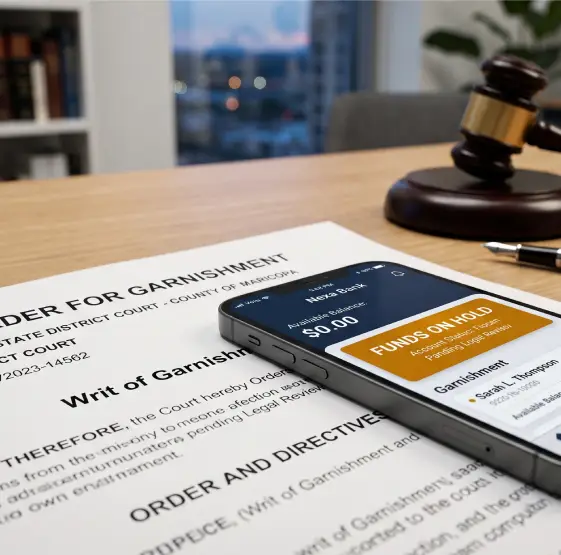
What Is Bank Garnishment?
Bank garnishment is a legal process that allows a creditor to freeze and potentially seize funds from your bank account to satisfy a court judgment.
This typically occurs after a creditor has already obtained a judgment against you. The creditor files a writ of garnishment directed at your bank, which then freezes funds up to the amount of the judgment.
Depending on the jurisdiction, you may not receive notice until after the account is frozen. At that point, you may have limited opportunities to challenge the garnishment, claim exemptions, or dispute errors in the process.
How Does the Process Work?
Understanding each stage of a bank garnishment — and where a defense can be raised.
Wage garnishment follows a different path, and the steps and timelines vary by jurisdiction.
What Is a Turnover Receivership?
A “Turnover Receiver” is a third party that, at the request of the judgment-creditor, courts in certain jurisdictions may appoint to freeze bank accounts, seize funds, and/or seize and liquidate other assets to satisfy a court judgment.
Courts can appoint them only after a judgment has been rendered, and only at the judgment-holder's request. Depending on the jurisdiction, the judgment-debtor may not receive notice of the application or the appointment. Judgment-debtors often learn that a receiver has been appointed only when their bank accounts are frozen.
Once appointed, the receiver is considered an “extension of the court” with broad power to freeze bank accounts, seize non-exempt funds, and seize or liquidate other non-exempt assets to satisfy a court judgment.

Why Clients Choose Debt Defenders:Our Proven 3-Step Process
At Debt Defenders by Ciment Law Firm, PLLC, we work with individuals facing urgent financial disruptions caused by creditor actions such as garnishment.
Our Standards of Excellence guide every case. We take the time to understand your situation, explain your legal rights, and act quickly through our process.

Pictured here: Attorneys Daniel J. Ciment and Zack Lemelin with non-attorney support staff.
We guide you through optimal debt resolution options and secure a clear path forward.
Our legal team holds creditors accountable to the law, defending you against unfair practices.
Implement a long-term strategy to restore and strengthen your financial standing.
Timing and Legal Precision Matter
Many clients come to us after their accounts have already been frozen. In these situations, timing and legal precision are critical.
As a law firm, we can analyze the garnishment process, identify errors, and take legal action to protect your funds and financial stability.
Work with a law firm that can defend you. Take action to protect your funds today.


The individuals shown are actor portrayals and not actual clients of the firm.
What Makes Our Approach Different
- Attorney-led review of garnishment orders and court filings
- Ability to challenge improper or defective writs
- Identification of exempt or protected funds
- Fast response to time-sensitive financial issues
- Legal representation in court when necessary
- Strategic evaluation of broader debt solutions
- Focus on both immediate resolution and long-term stability
Our Law Firm vs. Debt Settlement, Consolidation, and Credit Repair
| Feature | Law Firm | Debt Settlement | Debt Consolidation | Credit Repair |
|---|---|---|---|---|
| Court Representation | ✔ | ✘ | ✘ | ✘ |
| Attorney-Client Privilege | ✔ | ✘ | ✘ | ✘ |
| Can Challenge Garnishment | ✔ | ✘ | ✘ | ✘ |
| Enforce Legal Violations | ✔ | ✘ | ✘ | ✘ |
| Long-Term Strategy | ✔ | Limited | Limited | Limited |
Your Rights Under Federal and State Consumer Protection Laws
Even when a creditor has a judgment, legal procedures must be followed.
- The Fair Debt Collection Practices Act (FDCPA), 15 U.S.C. § 1692 et seq., limits how collectors can act when pursuing debts.
- The Fair Credit Reporting Act (FCRA), 15 U.S.C. § 1681 et seq., may apply if garnishment is connected to inaccurate reporting.
- State laws also provide protections regarding exempt funds and proper garnishment procedures.
If violations occur, they may provide grounds to challenge the garnishment or pursue additional legal remedies.
Currently Serving Texas and Georgia
Debt Defenders represents consumers across Texas and Georgia. We currently offer bank garnishment defense, including turnover receivership matters and other post-judgment collection actions, to clients in Texas, and Georgia clients can work with our attorneys on debt lawsuit defense. When a creditor freezes your account or attempts to seize funds, quick action can make a significant difference.
Our attorneys review garnishment orders, identify exempt funds, analyze potential procedural errors, and explore available legal remedies to protect your financial interests. If your bank account has been frozen or money has already been removed, we can help you understand your rights and determine the most effective strategy for responding to the garnishment.
Frequently Asked Questions
Speak With a Garnishment Defense Attorney Today
A frozen bank account can disrupt your ability to cover essential expenses. Acting quickly can make a difference in protecting your funds.
Our attorneys work with you to review garnishments, challenge improper actions, and pursue available legal options.
Speak With a Garnishment Defense Attorney Today